
What the Sachet portal is and how to use it
Key facts at a glance
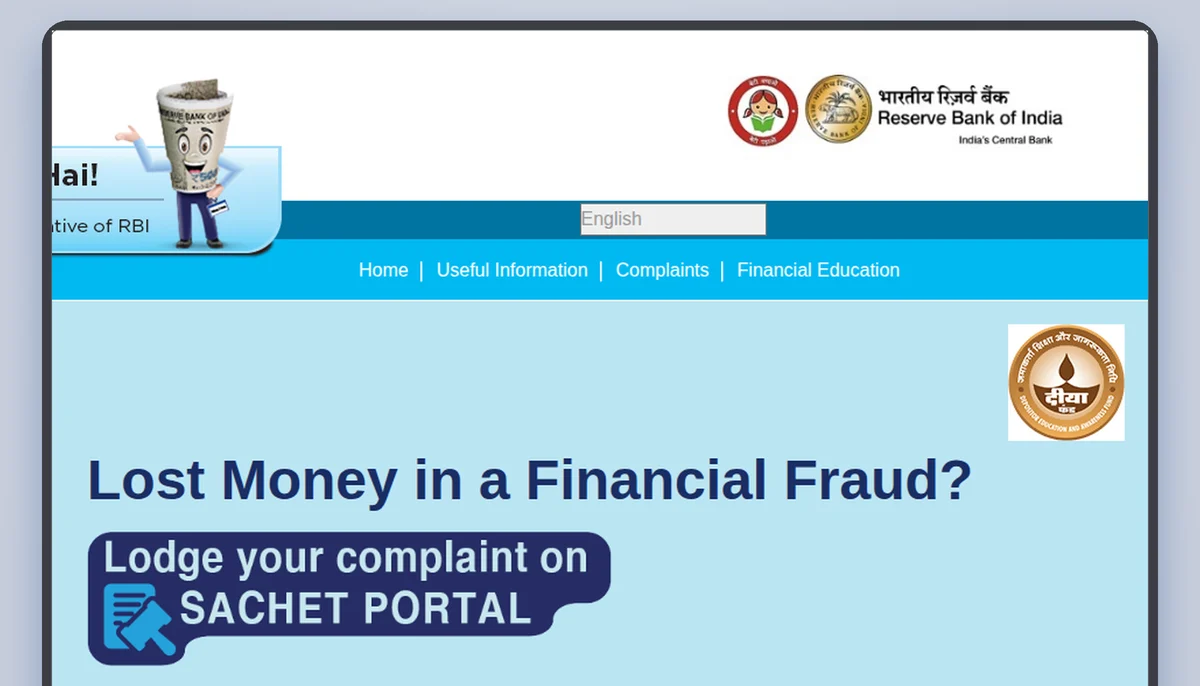
The Sachet portal is a government portal, coordinated with the Reserve Bank of India, where a person can report an unregulated deposit scheme or a suspected one to the relevant regulator. This page explains what to include in a complaint and what happens next in general terms. The portal does not recover money by itself.
What the Sachet portal is
The Sachet portal is a website run by the government, coordinated with the Reserve Bank of India, where a person can report an unregulated deposit scheme or a suspected one. The portal is designed to route complaints to the relevant regulator, such as the RBI, SEBI, or a state authority. It is not a recovery agency and does not return money to complainants.
The portal's name stands for 'Sachet', which means 'alert' in Hindi. It is part of the government's effort to curb unauthorised deposit-taking. The portal allows a person to file a complaint online, upload documents, and track the status. It also has a list of entities that are authorised to take deposits, so a person can check before investing.
What to include in a complaint
A complaint should include the name of the entity, the name of the person who took the money, the amount given, the date of payment, the promise made, and any documents received. The portal has fields for these details. The more complete the complaint, the easier it is for the regulator to act.
The complaint should also include the complainant's own details: name, address, phone number, and email. The portal may ask for proof of payment, such as a bank statement or a receipt. If the scheme was advertised on a website, the domain name can be included. The portal does not require a lawyer to file a complaint.
What happens after a complaint is filed
The portal forwards the complaint to the relevant regulator based on the type of scheme and the location. The regulator may investigate, ask for more information, or take action under its own law. The complainant can track the status on the portal. The time taken varies and is not fixed.
The regulator may also refer the complaint to the police or to a designated authority under the Banning of Unregulated Deposit Schemes law. The portal itself does not decide the outcome. The complainant may be contacted for more details. There is no fee to file a complaint on the portal.
What the portal does not do
The portal does not recover money by itself. It does not guarantee that the complainant will get any money back. It does not freeze accounts or attach assets on its own; those actions are taken by the regulator or the authority under the law. The portal is only a channel for reporting and routing.
The portal also does not give legal advice. It does not tell a person whether a scheme is safe or not. It is a tool for reporting after the fact. A person should still do their own checks before giving money to any scheme. The portal's list of authorised entities is a helpful check, but it is not a complete guarantee of safety.
When to use the Sachet portal
A person should use the Sachet portal if they have given money to a scheme that they suspect is unregulated, or if they have been approached by such a scheme. The portal can also be used to report a scheme that is advertising for deposits. The portal is not for complaints about banks or registered NBFCs; those have their own complaint mechanisms.
If a person is unsure whether a scheme is regulated, the portal has a search function to check authorised entities. If the scheme is not on the list, that is a warning sign, but not proof. The person can then file a complaint. The portal is one of several channels; a person can also complain to the police or to the designated authority under the Banning of Unregulated Deposit Schemes law.
What to have in hand before filing
Before filing a complaint on the Sachet portal, gather all documents: proof of payment, any agreement or receipt, any advertisement or website link, and the details of the person who took the money. Write down a clear sequence of events: when you first heard of the scheme, when you paid, what was promised, and what happened when you asked for your money back.
Having these in hand makes the complaint process faster and more effective. The portal will ask for these details, and the more complete the information, the better the regulator can act. Do not delay; the sooner a complaint is filed, the sooner the regulator can look into the scheme.
A complaint on Sachet is only as useful as the information it carries
The portal routes each complaint to the authority that oversees the activity the complaint describes. If the complaint mixes a banking dispute with a direct-selling grievance, the routing can slow down or stall. Three separate complaints are better than one long one that covers three different kinds of conduct.
The text box on the portal accepts a long narrative, but a long narrative is not the same as a precise one. The authority that reads the complaint does not know the context a complainant has in their head. A complaint that jumps from a WhatsApp forward to a bank statement to a company registration number forces the reader to guess which part matters.
Before typing, the complainant should decide which single wrong they want recorded first. The rest can go in a second complaint. This is not a limitation of the portal; it is how any routing desk works. A complaint that asks one clear question gets one clear action.
A complaint is a record, not a recovery order
The Sachet portal does not freeze an account, reverse a transfer, or return money to the complainant. It creates a written record of a grievance and sends that record to a regulator or enforcement agency. The agency then decides whether the facts, as described, fall within its remit and what priority to give them.
A complainant who expects the portal to behave like a bank's chargeback system will be disappointed. The portal is a reporting mechanism, not a resolution mechanism. The distinction matters because the reader's next step after filing is often to keep their own records and to stop communicating with the entity they have reported.
The value of the record grows when the same complaint arrives from several people. One complaint may sit in a queue. Twenty complaints about the same scheme, each with the same bank account or the same promoter's name, become a pattern that an investigator can act on. The portal works best when it is used early and used by many.
The portal asks for the complainant's identity for a reason
The Sachet portal requires the complainant to provide their name and contact details before the complaint is accepted. This is not an optional field. An anonymous complaint about a deposit scheme cannot be acted on because the regulator cannot verify that the complainant is real or that the described transaction happened.
Some complainants fear that the entity they report will learn their identity and retaliate. The portal does not publish complaint details, and the authority that receives the complaint is bound by its own confidentiality rules. But a complainant who is still in a business relationship with the entity should think through the consequences before naming themselves.
If the complainant is an employee or an agent of the entity they are reporting, the portal is not a whistleblower channel. The person may have separate protections under company law or employment law, but the Sachet complaint is a public record. The complainant should decide whether to file in their own name or through a legal representative.
What the complainant does after filing matters as much as the complaint itself
The Sachet portal gives the complainant a reference number. That number is the only proof that the complaint was filed. A complainant who loses the number or forgets the date of filing cannot later ask the authority for a status update. The number should be stored with the same care as a bank account number.
The portal does not send automatic progress updates. The complainant may have to write to the receiving authority separately and ask what action, if any, has been taken. That follow-up letter should mention the Sachet reference number and the date of filing. Without those two details, the authority has no way to locate the complaint.
A complainant who has given money to the entity should also preserve the bank statement, the payment receipt, the WhatsApp messages, and the scheme's website screenshots. These documents are not uploaded to the Sachet portal, but they will be needed later if the authority investigates or if the complainant files a police complaint.
The Sachet portal is not a substitute for other registers
The Sachet portal records complaints. It does not show whether a company is registered with the Ministry of Corporate Affairs, whether it has a direct-selling licence, or whether its website domain was created recently. A reader who checks only the Sachet portal has checked only one of the four records this site describes.
A company may have no complaints on Sachet and still be unregistered or unregulated. A company may have several complaints and still be lawfully registered. The portal is a snapshot of grievances, not a certificate of good standing. The reader who treats it as a certificate will miss the very mismatch this site keeps pointing at.
The right order is to check the company register first, then the Banning of Unregulated Deposit Schemes rules, then the direct-selling guidelines, and only then to file a Sachet complaint if the facts warrant it. Filing a complaint before checking the register can lead to a complaint that is misdirected or incomplete.
Read next
Is it a scheme or a business?
Is the Sachet portal only for unregulated deposit schemes?
Yes, the Sachet portal is specifically for reporting unregulated deposit schemes or suspected ones. It is not for complaints about banks, registered NBFCs, or other regulated entities. Those have their own complaint mechanisms, such as the RBI's complaint portal for banks.
Will the Sachet portal get my money back?
No, the Sachet portal does not recover money by itself. It routes your complaint to the relevant regulator, which may take action. Recovery of money depends on the regulator's action and the assets of the scheme. There is no guarantee of recovery.
Do I need a lawyer to file a complaint on Sachet?
No, you do not need a lawyer. The portal is designed for ordinary people to file complaints online. You need to provide details of the scheme and your own details, and upload any documents you have. The process is free.
What details should I include in the complaint?
Include the name of the entity, the name of the person who took the money, the amount, the date, the promise made, and any documents or website links. Also include your own name, address, phone number, and email. The more details, the better.
Can I report a scheme that has not taken my money yet?
Yes, you can report a scheme that is advertising for deposits or approaching people, even if you have not given money. The portal allows you to report a suspected scheme. This can help the regulator act early.
Opening a CFD account means reading the client agreement
This site links to FxPro, an international broker. Before opening an account, read the risk warning and the client agreement, and check the legal entity and regulator named in that agreement against the regulator's own register. CFDs are leveraged and carry a high risk of losing the money deposited.