
What the creation date of a website's domain is and what it cannot show
Key facts at a glance
This page explains what the creation date of a website's domain is and what it cannot show. A live table sits above the text, showing the domain as written in the regulator's entry, the creation date from public registration data, and the list the entry came from. The prose quotes no figure and names no entity.
Domains named in regulator lists, and their creation dates
Only domains that appear in an entry already published by SEBI or the RBI.
| Domain named on the RBI Alert List | Domain registered | List the entry came from | Source |
|---|---|---|---|
| August 2026 | |||
| mirrox.com | 05.08.2026 | RBI Alert List | ICANN ↗ |
| qfxmarkets.com | 07.08.2026 | RBI Alert List | ICANN ↗ |
| tradesightfx.co.in | 17.08.2026 | RBI Alert List | ICANN ↗ |
| March 2025 | |||
| finfxpro.com | 18.03.2025 | RBI Alert List | ICANN ↗ |
| October 2023 | |||
| tdfx.exchange | 07.10.2023 | RBI Alert List | ICANN ↗ |
| September 2023 | |||
| foxorex.com | 08.09.2023 | RBI Alert List | ICANN ↗ |
| August 2023 | |||
| anyfx.in | 25.08.2023 | RBI Alert List | ICANN ↗ |
| realgoldcapitals.com | 14.08.2023 | RBI Alert List | ICANN ↗ |
| July 2023 | |||
| yorkermarkets.com | 17.07.2023 | RBI Alert List | ICANN ↗ |
| May 2023 | |||
| dbgmarketsglobal.com | 09.05.2023 | RBI Alert List | ICANN ↗ |
| plusonetrade.com | 17.05.2023 | RBI Alert List | ICANN ↗ |
| April 2023 | |||
| nxgmarkets.com | 26.04.2023 | RBI Alert List | ICANN ↗ |
| February 2023 | |||
| grow-line.org | 13.02.2023 | RBI Alert List | ICANN ↗ |
| February 2022 | |||
| jgcfx.com | 11.02.2022 | RBI Alert List | ICANN ↗ |
| January 2022 | |||
| fvpt-uk.com | 18.01.2022 | RBI Alert List | ICANN ↗ |
| November 2021 | |||
| fxsmartbull.com | 24.11.2021 | RBI Alert List | ICANN ↗ |
| October 2021 | |||
| smartproptrader.com | 02.10.2021 | RBI Alert List | ICANN ↗ |
| August 2021 | |||
| fxtray.com | 31.08.2021 | RBI Alert List | ICANN ↗ |
| April 2021 | |||
| brictrade.com | 26.04.2021 | RBI Alert List | ICANN ↗ |
| January 2021 | |||
| ntstradingrobot.com | 04.01.2021 | RBI Alert List | ICANN ↗ |
| October 2020 | |||
| finowiz.com | 13.10.2020 | RBI Alert List | ICANN ↗ |
| May 2020 | |||
| 2wintrade.com | 22.05.2020 | RBI Alert List | ICANN ↗ |
| binomoidr.com | 29.05.2020 | RBI Alert List | ICANN ↗ |
| godofx.com | 28.05.2020 | RBI Alert List | ICANN ↗ |
| rubiktrade.com | 22.05.2020 | RBI Alert List | ICANN ↗ |
| January 2020 | |||
| enclavefx.com | 11.01.2020 | RBI Alert List | ICANN ↗ |
| inefex.com | 20.01.2020 | RBI Alert List | ICANN ↗ |
| December 2019 | |||
| gurutrade7.com | 02.12.2019 | RBI Alert List | ICANN ↗ |
| October 2019 | |||
| octaindia.net | 14.10.2019 | RBI Alert List | ICANN ↗ |
| July 2019 | |||
| puprime.com | 30.07.2019 | RBI Alert List | ICANN ↗ |
| April 2019 | |||
| fundednext.com | 17.04.2019 | RBI Alert List | ICANN ↗ |
| August 2018 | |||
| tpglobalfx.com | 29.08.2018 | RBI Alert List | ICANN ↗ |
| May 2018 | |||
| starnetfx.com | 28.05.2018 | RBI Alert List | ICANN ↗ |
| December 2017 | |||
| vantagemarkets.com | 18.12.2017 | RBI Alert List | ICANN ↗ |
| vtmarkets.com | 18.12.2017 | RBI Alert List | ICANN ↗ |
| August 2017 | |||
| cabanacapitals.com | 10.08.2017 | RBI Alert List | ICANN ↗ |
| December 2016 | |||
| justmarkets.com | 21.12.2016 | RBI Alert List | ICANN ↗ |
| August 2016 | |||
| yamarkets.com | 23.08.2016 | RBI Alert List | ICANN ↗ |
| July 2016 | |||
| pocketoption.com | 21.07.2016 | RBI Alert List | ICANN ↗ |
| July 2014 | |||
| tickmill.com | 08.07.2014 | RBI Alert List | ICANN ↗ |
| April 2014 | |||
| olymptrade.com | 14.04.2014 | RBI Alert List | ICANN ↗ |
| April 2013 | |||
| bdswiss.com | 09.04.2013 | RBI Alert List | ICANN ↗ |
| iq-option.com | 10.04.2013 | RBI Alert List | ICANN ↗ |
| November 2011 | |||
| fxroad.com | 03.11.2011 | RBI Alert List | ICANN ↗ |
| July 2011 | |||
| octafx.com | 28.07.2011 | RBI Alert List | ICANN ↗ |
| June 2011 | |||
| icmarkets.com | 19.06.2011 | RBI Alert List | ICANN ↗ |
| August 2010 | |||
| fusionmarkets.com | 18.08.2010 | RBI Alert List | ICANN ↗ |
| July 2009 | |||
| freshforex.com | 09.07.2009 | RBI Alert List | ICANN ↗ |
| fxprimus.com | 07.07.2009 | RBI Alert List | ICANN ↗ |
| November 2008 | |||
| urbanforex.com | 22.11.2008 | RBI Alert List | ICANN ↗ |
| August 2008 | |||
| exness.com | 26.08.2008 | RBI Alert List | ICANN ↗ |
| May 2008 | |||
| nordfx.com | 20.05.2008 | RBI Alert List | ICANN ↗ |
| April 2008 | |||
| avatrade.com | 20.04.2008 | RBI Alert List | ICANN ↗ |
| February 2008 | |||
| ironfx.com | 10.02.2008 | RBI Alert List | ICANN ↗ |
| October 2007 | |||
| expertoption.com | 02.10.2007 | RBI Alert List | ICANN ↗ |
| June 2007 | |||
| iforex.in | 01.06.2007 | RBI Alert List | ICANN ↗ |
| February 2007 | |||
| hotforex.com | 20.02.2007 | RBI Alert List | ICANN ↗ |
| November 2006 | |||
| hycm.com | 20.11.2006 | RBI Alert List | ICANN ↗ |
| April 2006 | |||
| admiralmarkets.com | 24.04.2006 | RBI Alert List | ICANN ↗ |
| March 2006 | |||
| capplace.com | 02.03.2006 | RBI Alert List | ICANN ↗ |
| December 2005 | |||
| metatrader5.com | 16.12.2005 | RBI Alert List | ICANN ↗ |
| June 2005 | |||
| infinox.com | 27.06.2005 | RBI Alert List | ICANN ↗ |
| November 2004 | |||
| etoro.com | 26.11.2004 | RBI Alert List | ICANN ↗ |
| metatrader4.com | 11.11.2004 | RBI Alert List | ICANN ↗ |
| July 2004 | |||
| fpmarkets.com | 10.07.2004 | RBI Alert List | ICANN ↗ |
| June 2004 | |||
| forex4money.com | 16.06.2004 | RBI Alert List | ICANN ↗ |
| May 2004 | |||
| weltrade.com | 05.05.2004 | RBI Alert List | ICANN ↗ |
| December 2003 | |||
| easymarkets.com | 06.12.2003 | RBI Alert List | ICANN ↗ |
| October 2003 | |||
| tdameritrade.com | 10.10.2003 | RBI Alert List | ICANN ↗ |
| July 2003 | |||
| forex4you.com | 07.07.2003 | RBI Alert List | ICANN ↗ |
| June 2003 | |||
| quotex.com | 04.06.2003 | RBI Alert List | ICANN ↗ |
| April 2003 | |||
| forextime.com | 06.04.2003 | RBI Alert List | ICANN ↗ |
| October 2002 | |||
| alpari.com | 16.10.2002 | RBI Alert List | ICANN ↗ |
| January 2002 | |||
| pepperstone.com | 20.01.2002 | RBI Alert List | ICANN ↗ |
| November 2001 | |||
| ftmo.com | 16.11.2001 | RBI Alert List | ICANN ↗ |
| June 2000 | |||
| fxstreet.com | 19.06.2000 | RBI Alert List | ICANN ↗ |
| December 1999 | |||
| thinkmarkets.com | 17.12.1999 | RBI Alert List | ICANN ↗ |
| November 1999 | |||
| trive.com | 26.11.1999 | RBI Alert List | ICANN ↗ |
| July 1999 | |||
| fxcm.com | 01.07.1999 | RBI Alert List | ICANN ↗ |
| March 1999 | |||
| blackbull.com | 31.03.1999 | RBI Alert List | ICANN ↗ |
| November 1998 | |||
| ig.com | 14.11.1998 | RBI Alert List | ICANN ↗ |
| June 1997 | |||
| forex.com | 22.06.1997 | RBI Alert List | ICANN ↗ |
| September 1995 | |||
| xtb.com | 16.09.1995 | RBI Alert List | ICANN ↗ |
| January 1995 | |||
| fbs.com | 23.01.1995 | RBI Alert List | ICANN ↗ |
| September 1994 | |||
| xm.com | 21.09.1994 | RBI Alert List | ICANN ↗ |
| October 1993 | |||
| hfm.com | 12.10.1993 | RBI Alert List | ICANN ↗ |
| No registration date in RDAP | |||
| fx-nice.net | No registration date in RDAP | RBI Alert List | ICANN ↗ |
| fxwestern.com | No registration date in RDAP | RBI Alert List | ICANN ↗ |
| growingcapital.uk | No registration date in RDAP | RBI Alert List | ICANN ↗ |
| ibellmarkets.com | No registration date in RDAP | RBI Alert List | ICANN ↗ |
| rangercapital.net | No registration date in RDAP | RBI Alert List | ICANN ↗ |
| tnfx.co | No registration date in RDAP | RBI Alert List | ICANN ↗ |
What the domain creation date is
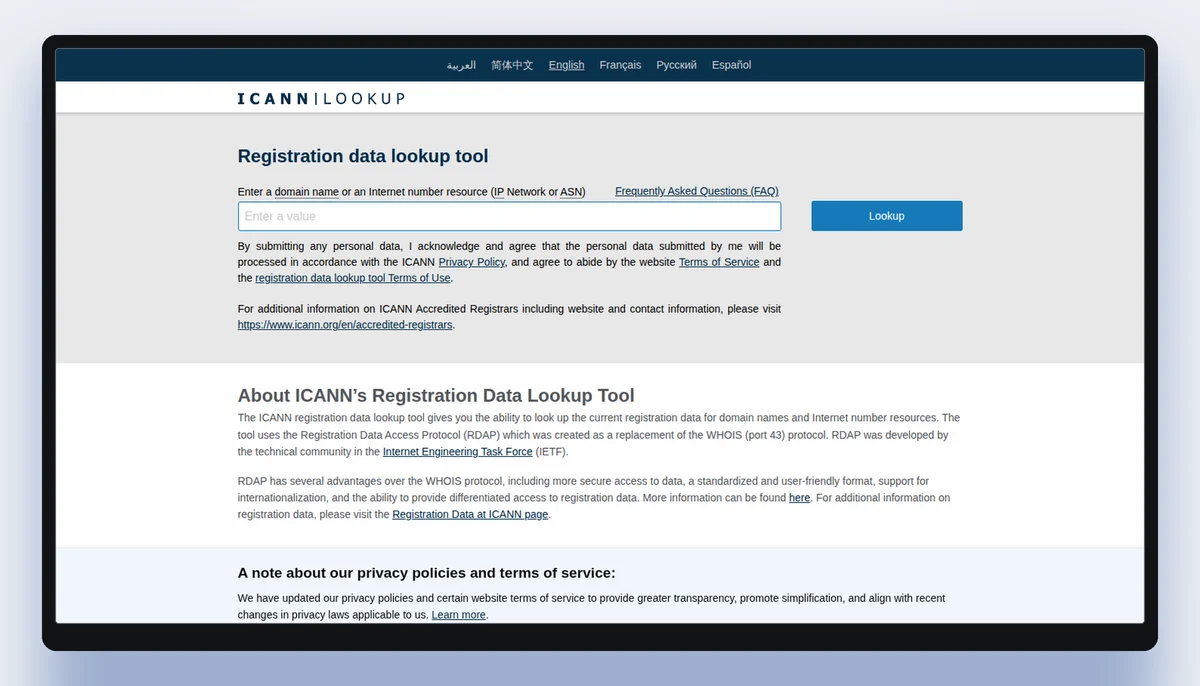
A domain creation date is the date on which the domain name was first registered in the public registration system. It is read from RDAP or WHOIS data when the domain is first added to the table and rechecked monthly. The date does not show when the website was first published, when the business started, or when the domain was last transferred.
The date is a fact about the domain name, not about the website or the business. A domain can be registered and left unused for years. A domain can be transferred to a new owner without changing the creation date. A domain can be re-registered after lapsing, which would give a new creation date.
What the table above shows
The table above shows three columns: the domain as written in the regulator's entry, the creation date from public registration data, and the list the entry came from. The domain is shown exactly as the regulator wrote it; no correction is made. The creation date is the one currently visible in the registration data at the time of the last check.
The list column names the source: SEBI cautions or the RBI Alert List. The table does not rank the domains, does not infer anything from the dates, and does not name any entity in the prose. The table is a record of what the regulator published and what the registration data shows.
What a creation date cannot show
A creation date cannot show who operates the site, where the business is run, or what the site promises. It cannot show whether the site is legitimate or a fraud. A young domain is not evidence of wrongdoing, and an old domain is not evidence of trust. The date is only one observational clue.
The date also cannot show whether the domain was previously used for something else. A domain can be transferred to a new owner, and the creation date would remain the same. A domain can be hidden behind a privacy service, so the creation date may be the only public fact. The date says nothing about the content of the site.
How to read the date with other records
The domain creation date should be read alongside the company register and the regulator's warning list. If a company was incorporated recently and its domain was also created recently, that is consistent but not proof of anything. If the domain was created long before the company was incorporated, the domain may have belonged to someone else.
The date can also be compared with the dates of the regulator's cautions. A domain created after the caution may indicate a rebrand or a new attempt. A domain created before the caution may have been used by the same scheme for a long time. These are questions, not answers.
Why this site does not infer from the date
This site does not call any entity a scam or a fraud, does not accuse a named entity, and does not name an entity in the prose. A listing in a regulator's warning list is a regulator's act, not this site's verdict. A young domain is not evidence of wrongdoing, and an old domain is not evidence of trust.
The site refuses to infer that a young domain means a scheme is suspicious, because a legitimate new business also has a young domain. The site refuses to infer that an old domain means a scheme is safe, because a fraud can use an old domain. The date is only a clue, and the reader decides.
What to have in hand before deciding
Before deciding about a scheme, have in hand: the company's record from the Ministry of Corporate Affairs, the regulator's warning list entry, and the domain creation date. Check whether the company is authorised to take deposits, if that is what it does. Read the Sachet portal's guidance on how to report a suspected scheme.
The domain creation date is the weakest of these records. It is a fact about the domain name, not about the business. The reader should use it as a starting question: why does this date not match the claims? Then look at the other records for answers.
A domain registered long ago may have changed hands without any public trace
Domain ownership records are not like land records. When a domain expires and is not renewed, it falls into a deletion cycle and can be picked up by anyone. The public creation date shown in the table above does not update when the registrant changes. A domain created years ago may have been owned by several different people or companies during that time.
The registry keeps the original creation timestamp as a fixed point, while the current owner may have acquired the domain recently. This matters because a scheme named in a regulator list may operate on a domain that looks old but was actually bought from a reseller. The apparent age of the domain then gives a false sense of continuity with the original registrant.
Readers comparing the creation date with the incorporation date of a company should remember this gap. The domain's age is not evidence of how long the current operator has used it. Only a paid historical whois service or archived copies of the site can hint at past use, and even those are incomplete. The table shows only what the registry records as the first creation.
A domain created before the company existed often points to a template or a parked page
The Ministry of Corporate Affairs register shows when a company was incorporated. If the domain creation date is earlier than that, the domain cannot have been used by the company for its current business from the start. The gap between the two dates is a useful observation. It may mean the domain was registered by a founder before incorporating, or it may mean the domain was bought later from someone who held it unused.
A domain that predates the company by several years is often a domain that was 'parked' or used for a different purpose. Parked pages show advertisements and are not evidence of any business activity. The current company may have purchased the domain because the name was available and looked credible due to its age. The creation date alone cannot distinguish these cases.
When a regulator lists a scheme and the table shows a domain older than the company, the reader should not assume the domain was used for the same scheme earlier. It is more likely the domain was acquired for its age. The older a domain looks, the more trust it may generate, and some operators know this. The date is a fact, but its meaning changes when placed beside the incorporation record.
The registry may show a creation date that is later than the date the regulator first named the domain
Regulator lists are published at a point in time, and the domain they name may be the one they saw on the day of the order. Sometimes a scheme changes its domain after being named, and the new domain will have a later creation date. The table above shows the creation date of the domain as written in the regulator's list, not the date of the regulator's order. If the domain was created after the order, that is a mismatch worth noting.
A domain created after the regulator's list was published cannot have been the domain used at the time of the alleged activity. This could mean the regulator recorded a domain that the scheme later abandoned, or it could mean the scheme registered a new domain to continue under a different name. The creation date then serves as a clue that the domain in the list may not be the one originally used.
Readers who compare the regulator's publication date with the domain creation date can spot this pattern. If the creation date is later, the named domain was not the original. It may be a redirect or a replacement. The table does not track changes to the domain after the list was published, so the creation date is the only fixed reference. What the domain used to be is not visible in the current record.
A domain can be created today for a scheme that was operating offline for years
Many deposit-taking schemes in India begin offline, through agents and word of mouth. A website may come later, when the scheme wants to reach more people or appear modern. The creation date of the domain then tells us only when the website appeared, not when the scheme started taking money. A scheme that has been operating for years may have a domain that is only a few months old.
The table above shows domains that are named in regulator lists, and some of those domains will have recent creation dates. That does not mean the scheme itself is new. It means the website is new. The scheme may have been collecting money through other channels long before the domain was registered. The domain creation date is a poor proxy for the age of the scheme.
Readers who treat a recent domain as a sign of a new scheme may underestimate how long it has been active. The opposite is also true: an old domain may belong to a scheme that started recently but bought an aged domain. To know when a scheme started, the reader must look at the company incorporation date, if any, and the dates in the regulator's order. The domain date alone cannot answer that.
The creation date does not show whether the domain was registered by the scheme or by a third party
Domain registration records are not always in the name of the company that runs the website. A scheme may register a domain through a proxy service, a web developer, or an employee. The public whois record may show a privacy service or an unrelated name. The creation date remains the same regardless of who registered it, but the identity of the registrant is hidden or misleading.
This matters because a reader cannot assume the domain was registered by the company named in the regulator list. The domain may have been registered by someone else and later transferred, or it may be registered by a third party who leases it to the scheme. The creation date does not reveal any of this. It is simply the date the domain first appeared in the registry.
When a regulator lists a domain, the table shows only the domain and its creation date, not the registrant. If the registrant were visible, it might show a different name from the company. That would be another mismatch to note, but the table does not include it. The reader should not infer ownership from the creation date. Ownership requires a separate whois lookup, and even that may be obscured.
Read next
Is it a scheme or a business?
What is a domain creation date?
A domain creation date is the date on which the domain name was first registered. It is read from public registration data, such as RDAP or WHOIS. It does not show when the website was published or who operates it.
Does a young domain mean the site is a fraud?
No. A young domain is not evidence of wrongdoing. A legitimate new business also has a young domain. The date is only one clue, and it must be read with other records such as the company register and the regulator's warning list.
Does an old domain mean the site is safe?
No. An old domain is not evidence of trust. A fraud can use an old domain, or a domain can be transferred to a new owner. The date says nothing about the current operator or the legitimacy of the business.
Why does the table show the domain as written by the regulator?
The table shows the domain exactly as the regulator wrote it in the warning list entry. No correction is made, because the reader may want to compare with the regulator's own page. The creation date is read from public registration data for that domain.
What should I do if I see a domain on the list?
If you see a domain on the list, check the company's record in the Ministry of Corporate Affairs, check whether the company is authorised to take deposits, and consider reporting on the Sachet portal. The domain date is only a clue; it is not proof of wrongdoing.
Opening a CFD account means reading the client agreement
This site links to FxPro, an international broker. Before opening an account, read the risk warning and the client agreement, and check the legal entity and regulator named in that agreement against the regulator's own register. CFDs are leveraged and carry a high risk of losing the money deposited.