
What the Banning of Unregulated Deposit Schemes law does
Key facts at a glance
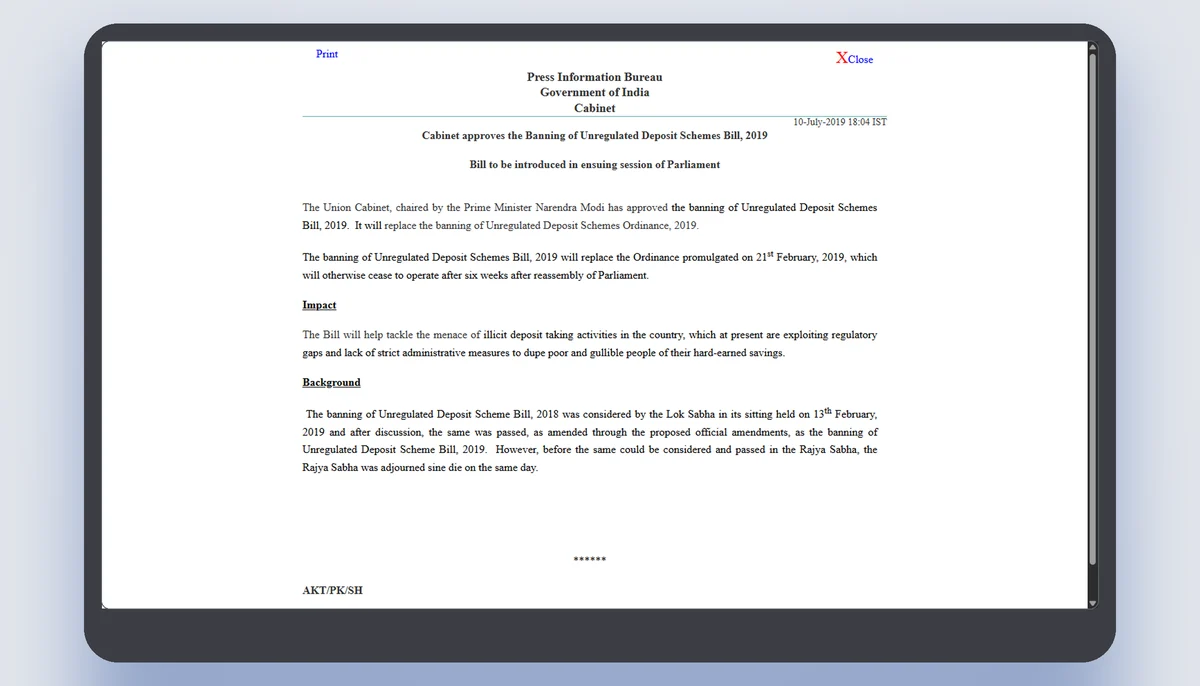
This page explains the Banning of Unregulated Deposit Schemes law. It prohibits running or promoting deposit-taking schemes that are not regulated under a specific law, defines a deposit broadly, and provides for designated authorities and courts to deal with them. The page does not give penalties or numbers, and does not name any business.
What the law prohibits
The law prohibits a person from running or promoting a deposit-taking scheme that is not regulated under a specific law. A scheme is a deposit-taking scheme if it accepts deposits from the public or a section of the public. Promoting includes advertising, inviting, or inducing others to deposit money. The prohibition applies even if the scheme is run by a company, a partnership, or an individual.
The law is designed to catch schemes that take money from the public without being authorised under a sector law. A person who runs such a scheme may be dealt with under the law, but this page does not give penalties. The key point is that the law makes the act of running an unregulated deposit scheme unlawful, regardless of what the money is called.
How the law defines a deposit
A deposit is defined broadly as money received by way of an advance, a loan, or in any other form, with a promise to return it, whether with or without interest or any other benefit. The definition includes money received as a membership fee, a subscription, or a contribution. It does not include amounts received in the ordinary course of trade or business, such as payment for goods or services actually delivered.
The breadth of the definition means that many schemes that claim not to be deposits may still fall within the law. The law lists certain amounts that are not deposits, such as amounts received from relatives or from a registered company as a loan. A reader should look at the full definition in the law, but the general idea is that any money taken with a promise to return it is likely a deposit.
What 'regulated' means
A deposit-taker is regulated if it is authorised under a sector law to accept deposits. The main sector laws are the Banking Regulation Act, which authorises banks; the Reserve Bank of India Act, which authorises non-banking financial companies; and the Companies Act, which allows certain companies to accept deposits subject to conditions. Other laws regulate specific entities, such as cooperative societies and insurance companies.
If a person or entity is not authorised under any of these laws to accept deposits, then any deposit-taking scheme it runs is unregulated. The law does not create a new regulator; it relies on the existing regulators to authorise deposit-takers. A reader can check with the relevant regulator whether an entity is authorised to accept deposits.
Designated authorities and courts
The law provides for designated authorities to receive complaints and to take action against unregulated deposit schemes. A designated authority is a government officer appointed for a particular area. The authority can investigate and can attach assets of the scheme. The law also provides for special courts to try offences under the law.
A person who has deposited money in an unregulated scheme can complain to the designated authority or to the police. The law also allows the authority to act on its own if it comes to know of a scheme. The process is separate from the Sachet portal, which is a central complaint portal. The law is enforced by the states and union territories, each of which appoints its own designated authorities.
What the law does not do
The law does not create a fund to repay depositors. It does not guarantee that a depositor will get money back. It does not make a scheme safe because it is registered as a company or because it has a website. Registration as a company is not permission to take deposits. The law only makes it possible to take action against those who run unregulated schemes.
The law also does not apply to deposits that are regulated under another law, such as bank deposits or deposits with a registered NBFC. A reader should not assume that an entity is safe because it is not on a warning list. The absence of a warning is not a guarantee. The reader should check the entity's authorisation with the relevant regulator.
Questions a reader should ask
Before giving money to any scheme, a reader should ask: Is the entity authorised to accept deposits under a sector law? Which regulator has authorised it? Is the money being taken as a deposit or as payment for goods or services? What is the promise of return? The answers to these questions should be verified from the regulator's own records, not from the scheme's website.
The law is a tool for action after the fact, but the reader's first protection is to check before paying. The Ministry of Corporate Affairs register shows whether a company exists, but not whether it may take deposits. The Sachet portal is where a suspected unregulated scheme can be reported. The domain creation date is only a clue and is not evidence of compliance.
A deposit is not the same as an investment
The law draws a line between money placed with an expectation of return and money placed with an expectation of capital appreciation. In a deposit, the person giving money is promised a fixed or variable return, but the return is not linked to the performance of any asset or business. The law treats this as a borrowing, even when the papers call it a plan, a scheme, or a contribution.
An investment, by contrast, puts the money at risk in an enterprise, and the return depends on how that enterprise performs. Many unauthorised schemes use investment language to disguise what is functionally a deposit: a promise to repay the principal with interest or profit, regardless of the underlying activity. The law looks at the substance of the arrangement, not the label used in the brochure.
This distinction matters because regulated investments have their own regulators and disclosure rules, while unregulated deposits are the specific target of this law. If a promoter says the money is safe and will grow by a set amount, the arrangement is being described as a deposit even if it is called a business partnership or a purchase of goods. The reader should ask what happens to the money if the business earns nothing.
Why a company with a registration certificate can still be barred from taking deposits
A certificate of incorporation from the Ministry of Corporate Affairs proves that a company exists, not that it may accept money from the public. The law on unregulated deposits operates separately from company registration, and it lists which entities are allowed to take deposits and under what conditions. A newly incorporated company has not thereby become a bank, a non-banking financial company, or any other regulated deposit-taker.
The register of companies shows the objects for which a company is formed, but those objects are not a licence. A company may list 'finance' or 'investment' among its objects and still be barred from taking deposits unless it holds a specific registration from the Reserve Bank or another regulator. The law makes it an offence to run an unregulated deposit scheme even if the company's registration is valid and its directors are named.
This is why a company search alone cannot tell a reader whether a scheme is lawful. The search may show that the company was incorporated recently, or that its authorised capital is small, but those facts do not themselves make the scheme illegal. The reader must check the other registers: the RBI's list of entities authorised to accept deposits and the Sachet portal for complaints. A company record is the first step, never the last.
The law reaches beyond the promoter to those who help run the scheme
The Banning of Unregulated Deposit Schemes law does not punish only the person who collects the money. It covers those who aid or abet the scheme, including persons who manage the office, maintain the records, or advertise the scheme to potential depositors. A person who knowingly allows their premises to be used for collection, or a bank manager who facilitates the deposits, can be proceeded against.
This extended liability means that a person cannot escape by saying they were only an employee or a contractor. The law asks whether the person knew or ought to have known that the scheme was unregulated. If the person benefited from the scheme, such as by receiving a salary or commission from the deposits, that benefit can be attached and confiscated by the designated authority.
For a reader, this matters because it changes the question from 'who is the promoter' to 'who is involved'. A scheme may be run by a company, but the people answering the phone, signing the receipts, or hosting the website may each bear responsibility. When filing a complaint, a reader should name every person and entity they know to be involved, not just the front-facing name.
What happens to the money after a scheme is declared illegal
Once a designated authority has reason to believe that a scheme is an unregulated deposit scheme, it can pass an order to attach the deposits and the assets acquired from them. This attachment is provisional and must be confirmed by a court, but it prevents the promoter from moving the money out of reach. The law allows for the sale of these assets to repay depositors.
The repayment is not automatic and is not guaranteed to be full. The designated authority must first determine who is a depositor and how much each is owed. The law gives priority to depositors over other creditors, but the amount recovered depends on what assets are found and sold. If the promoter has spent the money or transferred it to relatives, the recovery may be partial.
A reader who has given money to a scheme should not wait for a conviction to file a claim. The law provides for interim measures and for the appointment of a competent authority to manage the attached assets. The sooner a complaint is filed on the Sachet portal, the sooner the designated authority can act to preserve what remains. Delay works in favour of the promoter, not the depositor.
Why a scheme that calls itself 'regulated' may still be unlawful
The word 'regulated' has a specific meaning in this law: the deposit-taking activity must be regulated by one of the named regulators, such as the Reserve Bank, the Securities and Exchange Board, or a state government. A scheme cannot make itself regulated by stating so in its brochure or on its website. The regulation must come from a statute that expressly permits the entity to take deposits.
Many schemes borrow the language of regulation without holding any licence. They may say they are 'registered with the Ministry of Corporate Affairs' or 'approved by the government', but those statements do not make them regulated deposit-takers. A company registration is not a deposit-taking licence, and a government approval for some other activity does not extend to taking money from the public.
The reader should ask for the specific provision of law under which the entity is allowed to take deposits, and then verify that provision with the regulator. A refusal to give the provision, or a vague reference to 'government rules', is a warning sign. The law does not allow a person to claim good faith reliance on the promoter's assurance; the burden is on the person taking the money to show that the deposit is regulated.
Read next
Is it a scheme or a business?
What is an unregulated deposit scheme?
An unregulated deposit scheme is any scheme that takes deposits from the public without being authorised under a sector law such as banking, company law, or the RBI Act. The law prohibits running or promoting such schemes. It does not matter what the scheme calls the money.
How do I know if an entity is authorised to take deposits?
Check with the regulator that oversees the sector. Banks are authorised by the Reserve Bank of India. Non-banking financial companies are also authorised by the RBI. Companies may be allowed to take deposits under the Companies Act, but only if they meet conditions. The regulator's website will list authorised entities.
What should I do if I have already given money to a scheme?
You can complain to the designated authority for your area or to the police. The law provides for designated authorities to investigate and attach assets. You can also report on the Sachet portal. The law does not guarantee that you will get your money back, but it provides a route for action.
Does registration as a company mean the company can take deposits?
No. Registration as a company under the Companies Act only means that the company exists as a legal entity. It does not give permission to take deposits. A company can take deposits only if it is authorised under a specific law and meets the conditions. Check the authorisation separately.
Is a website's domain creation date evidence of wrongdoing?
No. A domain creation date only shows when the website's domain was registered. It can be transferred, hidden behind a privacy service, or re-registered. It says nothing about the operator or the legality of the scheme. It is only one clue among several records.
Opening a CFD account means reading the client agreement
This site links to FxPro, an international broker. Before opening an account, read the risk warning and the client agreement, and check the legal entity and regulator named in that agreement against the regulator's own register. CFDs are leveraged and carry a high risk of losing the money deposited.