
How Indian consumer rules separate lawful direct selling from pyramid arrangements
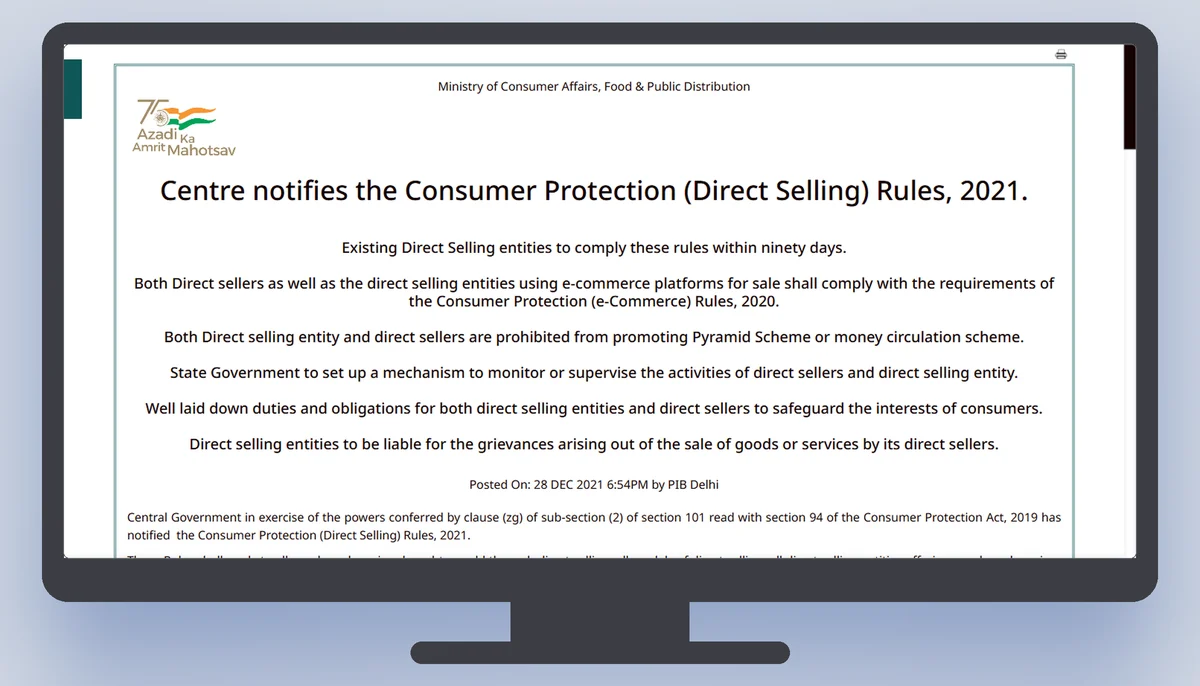
Key facts at a glance
Indian consumer rules separate lawful direct selling from pyramid arrangements in words: a direct seller sells goods or services to consumers and is paid on those sales; an arrangement that pays mainly for enrolling members is not allowed. The rules put duties on direct-selling entities such as written terms and a grievance route. This page does not cite rule numbers or dates.
What lawful direct selling is
Lawful direct selling is a business where a seller sells goods or services directly to consumers, away from a fixed retail location. The seller is paid a commission or a margin on the sales made. The goods or services are real, and the consumer receives them. The seller may also recruit other sellers, but the primary income is from selling, not from recruiting.
The rules recognise direct selling as a legitimate business model. The seller is not an employee of the direct-selling entity but an independent contractor. The entity must have a written agreement with the seller, stating the terms of the relationship. The entity must also have a grievance redressal mechanism for consumers and sellers.
What a pyramid arrangement is
A pyramid arrangement is a scheme where a person pays to join, and the main way to earn money is by recruiting others who also pay to join. The product, if any, is secondary. The scheme is not sustainable because it requires an ever-increasing number of recruits. The rules prohibit such arrangements, and the Banning of Unregulated Deposit Schemes law may also apply if deposits are taken.
The key difference is where the money comes from. In lawful direct selling, money comes from selling goods or services to consumers. In a pyramid arrangement, money comes from the joining fees of new recruits. The rules make this distinction clear: an arrangement that pays mainly for enrolling members is not allowed.
Duties of direct-selling entities
The rules put duties on direct-selling entities. They must have a written contract with each seller, stating the terms of the relationship, the commission structure, and the termination conditions. They must provide a cooling-off period, during which a consumer or seller can cancel the agreement and get a refund. They must have a grievance redressal mechanism, with a designated officer and a time limit for resolution.
The entity must also be registered as a company or a firm, and it must maintain records of its sellers and sales. It must not charge an entry fee that is not related to the cost of a starter kit or training. It must not pay commission solely for recruiting new sellers. These duties are designed to protect consumers and sellers from unfair practices.
How to tell the difference
A reader can tell the difference by asking: What am I paying for? If the payment is for a product or service that I will use, and the commission is based on sales, it is likely lawful direct selling. If the payment is for the right to recruit others, and the commission is based on recruitment, it is likely a pyramid arrangement.
The reader should also ask: What is the main source of income for the seller? If the seller earns most from selling products, it is lawful. If the seller earns most from recruiting, it is not. The rules are clear: an arrangement that pays mainly for enrolling members is not allowed.
What to have in hand before joining
Before joining a direct-selling opportunity, have in hand: the written contract, the commission structure, the product details, and the grievance redressal mechanism. Read the contract carefully; it should state the cooling-off period and the refund policy. Check whether the entity is registered as a company or firm.
Also check whether the entity has a history of complaints. The consumer protection regulator may have a list of complaints. The Sachet portal is for unregulated deposit schemes, but a pyramid arrangement may also be reported there if it takes deposits. The Ministry of Corporate Affairs record shows whether the entity exists, but not whether it is lawful.
The limits of the rules
The rules do not guarantee that a direct-selling opportunity is profitable. They set standards for the relationship between the entity and the seller, but they do not promise that the seller will earn money. The seller's income depends on sales, and sales depend on the market. The rules also do not cover every possible arrangement; they are general principles.
The reader should be cautious of any opportunity that promises high income with little effort. The rules are a floor, not a ceiling. The reader should also check whether the entity is on any warning list from SEBI or the RBI, if it offers investments. The domain creation date of the entity's website is only a clue, not evidence.
A promoter cannot use a direct-selling registration to collect entry fees
The direct selling rules treat entry fees and demonstration kits differently from the money a distributor pays for goods they will resell. A lawful direct seller is allowed to charge for the actual products purchased, but the rules cap what can be taken merely to join the network or to stay active in it. When a promoter asks for a large upfront payment that is not matched by goods at a fair transfer price, the arrangement begins to look like a pyramid even if the paperwork says direct selling.
The test is whether the payment buys a right to recruit others rather than a right to sell products. If the main reason to pay is to unlock commissions from bringing in new members, the fee is functioning as an entry cost to a money circulation scheme. Consumer protection authorities look at what the distributor receives at the moment of joining, not at promises of future earnings from a downline.
A direct-selling entity that is genuinely selling goods will be able to show invoices, delivery challans and a buyback policy for unsold stock. Where the only document issued is a receipt for a 'starter pack' or 'business kit' priced far above its market value, the fee is being used to fund payouts to earlier members. That is the structure the rules were written to stop, regardless of what the scheme calls itself.
The mandatory cooling-off period changes how recruiters are trained to sell
The Consumer Protection Rules give every new direct seller a right to cancel their agreement within a set number of days and receive a refund for goods returned in good condition. Recruiters who know this rule cannot use high-pressure closing techniques that rely on the buyer not reading the contract. The cooling-off period forces the direct-selling entity to accept that some sales will be reversed, and to build that cost into its operations.
A recruiter who discourages a new distributor from reading the cancellation clause or who delays issuing the agreement is trying to outrun the cooling-off period. The rules require the agreement to state the cancellation right clearly, and a failure to do so is itself a violation. Consumer forums treat the absence of a written agreement as a sign that the entity is not following the direct selling framework.
This right works only if the distributor knows where to send the returned goods and who will process the refund. A lawful direct seller will have a named grievance officer and a published procedure for returns. A scheme that makes refunds difficult, demands the goods be sent to a different address than the one on the invoice, or claims the cooling-off period never applied has placed itself outside the consumer protection rules.
A direct seller cannot sell to the public from a shop unless it also complies with retail laws
The direct selling rules assume that sales happen away from a fixed retail location, usually in a home or through a personal network. When a direct-selling entity opens a storefront, a kiosk or a stall at an exhibition, it is no longer only a direct seller; it is also a retailer. That brings in additional obligations under local shops and establishments laws, GST invoicing rules and any licence required by the municipal authority for a physical trade premises.
The confusion arises because some direct sellers use a showroom only for product demonstrations and take orders online, while others allow walk-in customers to buy and carry goods away. The distinction matters for consumer rights: a buyer in a shop has different remedies than a buyer who ordered through a distributor. If the entity has not registered the premises as a shop, the buyer may not be able to trace the seller for warranty claims.
A direct-selling entity that wants to avoid this overlap will keep its premises as a stock point or training centre and will not display prices for off-the-street purchase. Where the public is invited in and goods are sold over the counter, the entity is operating a retail outlet and must follow the same labelling, MRP and billing rules as any other shop. The direct selling licence does not override those requirements.
The rules do not stop a distributor from borrowing money to buy stock
A common failure mode is a distributor who takes a personal loan, uses a credit card or borrows from family to buy the initial product pack because the recruiter promised the earnings would cover the repayment. The direct selling rules do not regulate how a distributor finances their purchase. They only regulate the relationship between the direct-selling entity and the distributor, not between the distributor and a lender.
This gap means a promoter can design a compensation plan that encourages large stock purchases without taking responsibility for the distributor's debt. The entity may argue that the distributor bought the goods voluntarily and that the loan was a personal choice. Consumer courts, however, have looked at whether the recruiter knew the distributor was borrowing and whether the promised buyback was honoured when the distributor could not sell.
The practical consequence is that a distributor should treat the first stock purchase as a cost, not an investment. If the goods cannot be sold at the stated price and the buyback policy has conditions that make it useless, the distributor is left with unsold stock and a loan to repay. The direct selling rules protect against unfair trade practices by the entity, but they cannot undo a personal borrowing decision.
A direct seller that does not issue an identity card is already in breach
The Consumer Protection Rules require every direct selling entity to issue a identity card to each distributor, and the card must carry the entity's name, the distributor's name and photograph, and the entity's contact details. This is not a formality; it is the document that proves the distributor is authorised to represent the entity. A recruiter who says the card will come later or that it is not needed for the first few sales has not understood the rule.
The identity card matters when a buyer wants to verify that the person at the door is a genuine distributor and not someone using the entity's name. It also matters for complaints: the card tells the consumer which entity to approach and which grievance officer to contact. Without a card, the buyer may not be able to prove that the sale was made by an authorised representative of the direct-selling entity.
A distributor who operates without a card is personally exposed. If a consumer files a complaint, the entity may deny that the distributor was acting on its behalf, and the absence of a card makes that denial easier. The rule places the burden on the entity to issue the card, but the distributor suffers the practical consequence: they are the one who cannot show authority when asked.
Read next
Is it a scheme or a business?
What is the difference between direct selling and a pyramid scheme?
In direct selling, income comes from selling goods or services to consumers. In a pyramid scheme, income comes mainly from recruiting new members who pay to join. The rules prohibit arrangements that pay mainly for enrolling members.
What duties do direct-selling entities have?
They must have written contracts with sellers, a cooling-off period, a grievance redressal mechanism, and they must not charge entry fees unrelated to costs. They must also be registered as a company or firm and maintain records.
Can I earn money by recruiting others?
You can earn a commission on sales made by people you recruit, but the commission must be based on product sales, not on recruitment itself. If the main income is from recruiting, it is not allowed.
What should I check before joining a direct-selling company?
Check the written contract, the commission structure, the product details, and the grievance mechanism. Also check the company's registration and any complaints against it. Be cautious of promises of high income with little effort.
Where can I complain about a pyramid scheme?
You can complain to the consumer protection regulator or to the police. If the scheme takes deposits, you can also report it on the Sachet portal. The Banning of Unregulated Deposit Schemes law may apply if deposits are taken.
Opening a CFD account means reading the client agreement
This site links to FxPro, an international broker. Before opening an account, read the risk warning and the client agreement, and check the legal entity and regulator named in that agreement against the regulator's own register. CFDs are leveraged and carry a high risk of losing the money deposited.